If you’ve tried this and still can’t sign in, contact your local office or email info@richardsonmediagroup.net.

Third-party data breaches rose 60% in a year. Most vendor reviews still happen once.

Many organizations still treat continuous risk monitoring as an advanced and optional part of GRC. When managing third-party risk, security questionnaire-based procurement and point-in-time vendor reviews are still the norm.
Modern vendor ecosystems are complex, and risk changes faster than traditional review cycles can keep up. Information from the last review goes stale fast, creating visibility gaps that leave you vulnerable to security and compliance risks. The impact is not theoretical anymore: Verizon’s 2026 Data Breach Investigations Report found that 48% of breaches involve a third party, up 60% from the previous year. As a result, implementing continuous risk monitoring has become the expected baseline in third-party risk management (TPRM).
In this guide, Vanta, an agentic trust platform, breaks down:
- How continuous risk monitoring bridges the visibility gap
- What effective monitoring looks like in practice
The biggest limitation of point-in-time risk monitoring
For many organizations, risk management has become a compliance-driven exercise. During procurement, teams rely on certifications and assessments like SOC 2, ISO 27001, or security questionnaires to evaluate vendor risk. While these provide useful assurance, they reflect point-in-time evaluations, not the vendor’s real-time security posture, operational maturity, or evolving risk exposure. A vendor can appear compliant on paper and still be a security liability.
As third-party incidents continue to rise, the limitations of static documentation and cyclical reviews are harder to ignore. According to SecurityScorecard’s 2026 Supply Chain Security Trends report, 86% of leaders express concern about supply chain risks.The same report found that 67% of organizations still rely on point-in-time security audits to assess third-party threats, which makes the evaluation somewhat biased.
The hidden cost of point-in-time vendor risk monitoring
The cost of point-in-time assessments isn’t limited to data breaches. You also face compounding issues, such as:
- Delayed incident response
- Operational disruption
- Escalating remediation costs
- Increased regulatory scrutiny or even penalties
- Reputational damage
Regulatory penalties and legal liability can be severe if you fail to demonstrate adequate third-party oversight. Continuous monitoring is mandated by several key regulations and standards related to information security, financial services, and data privacy. For example, breaching the GDPR will result in a fine of up to 20 million euros or 4% of your global annual turnover for the preceding financial year, whichever is higher.
Can continuous risk monitoring bridge the visibility gap?
Continuous monitoring replaces point-in-time visibility with ongoing oversight. This is made possible by leading GRC tools and solutions, which are designed to gather and analyze risk data from internal systems, external intelligence feeds, compliance repositories, and vendor ecosystems.
Instead of static data, continuous monitoring surfaces continuous risk signals that represent current exposure. Common signals include:
- Vendor breaches
- Common Vulnerabilities and Exposures (CVEs) affecting vendor systems
- Credential leaks
- Fourth-party risk indicators
- Compliance and audit lapses
- Expiration of key certifications and attestations
That flow of information helps TPRM programs move from periodic review cycles to always-on visibility, so you address threats and vulnerabilities as they emerge.
Move away from spreadsheets for continuous monitoring to work
From an operational perspective, many organizations struggle to integrate continuous monitoring because they layer it onto spreadsheet-based risk management and tooling built for periodic assessments, rather than rebuilding their processes around live risk signals.
“Teams remain stuck using spreadsheets because they are familiar, not because they work the best,” says Connor Snyder, GRC subject matter expert at Vanta. “For many organizations, their priority is still to focus on manual static evaluations instead of centralized continuous monitoring. The need for more mature and automated approaches to TPRM has never been more urgent.”
Continuous monitoring shouldn’t be bolted onto an existing TPRM program. Rebuild your operations with workflows for ownership, alerting, remediation, and exception management built around continuous risk signals.
The upfront investment in continuous monitoring is a common concern for many teams, as the ROI and savings can take time to materialize. However, the long-term benefits are tangible and come from reduced manual assessments, efficient and reliable evidence collection, consistent prioritization of high-risk vendors, and shorter review cycles that would otherwise consume significant staff hours.
Core components of continuous risk monitoring
Effective continuous risk monitoring is a product of governance and tooling. These components will shape your program:
- Integrations: Continuous oversight depends on integrations with your technology stack, including ticketing systems, cloud providers, and vulnerability scanners. Integrations provide the data needed to detect changes across vendor ecosystems and surface emerging third- and fourth-party risks.
- Defined KRIs, risk appetite, and tolerance levels: KRIs, risk appetite, and tolerance levels allow you to evaluate risk signals and standardize treatment.
- Risk scoring and prioritization: Build scoring methodologies into the program so you always know which risks need the most attention.
- Event-based escalation: Automated escalation processes surface risk events to relevant stakeholders based on defined triggers.
- Alert contextualization: Because an automated environment can lead to several alerts, your GRC tooling should be configured to distinguish between routine updates and exceptions. Apply the “so what?” test to determine what needs surfacing—examples of material impact include financial loss, reputational damage, and project delay.
- Ownership and remediation tracking: Assign a specific owner and remediation time frame to every risk in the continuous monitoring loop.
- Response plans for high-risk events: Define targeted actions owners should take during high-risk events, such as incidents and control failures.
- A single source of truth: Move away from scattered evidence and multiple versions of risk registers as they’re not compatible with continuous monitoring. Maintain a central dashboard with all risk information for shared context and decision-making.
What continuous risk monitoring in TPRM looks like in practice
The most notable shift with continuous TPRM is the switch from periodic to near-real-time oversight. In mature programs, risk detection is driven by live security signals, and response and remediation follow simultaneously. Questionnaires and compliance-based security artifacts are still present, but they’re treated as supporting evidence during audits instead of primary assurance tools.
With ownership and remediation embedded into day-to-day workflows, the human role shifts from manual coordination to strategic oversight, exception management, and risk validation. When risk events occur, escalation triggers automatically and routes to the owners. They can then begin remediation, with its progress visible centrally.
Remember that automation only does the detection and routing; it doesn’t replace human judgment.
“A common misconception in TPRM is that continuous monitoring can completely replace the need for more traditional vendor due diligence and periodic point-in-time reviews,” Snyder says. “In reality, continuous monitoring serves as a valuable tool to provide external risk signals, but it does not remove the need to still validate internal control effectiveness, governance processes, contractual obligations, or regulatory compliance.”
Additionally, AI complements continuous risk monitoring by accelerating due diligence. AI can review questionnaires and security documentation during onboarding, then support ongoing monitoring by analyzing risk signals and flagging changes to the security posture. This reduces manual effort while retaining consistent oversight as vendor ecosystems grow.
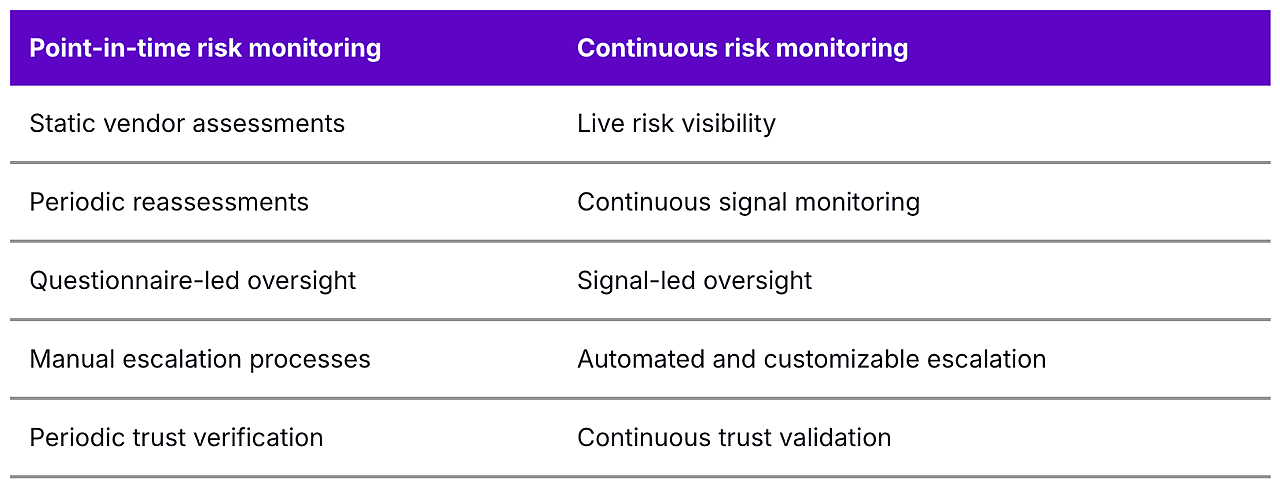
The differences between point-in-time and continuous risk monitoring are summarized below:
Best practices for continuous risk monitoring and TPRM
Continuous monitoring delivers the most value to your TPRM program when you follow these best practices:
- Integrate continuous monitoring across the vendor lifecycle: Embed continuous monitoring from initial onboarding through ongoing management and offboarding to maintain an auditable trail of risk signals.
- Implement tiered vendor monitoring: Apply monitoring at different intensities based on a vendor’s criticality and risk exposure. High-risk vendors get granular oversight, and you stop spreading resources evenly across vendors that don't need it.
- Regularly fine-tune risk scoring models: Revisit vendor scoring logic and thresholds and adapt them to any changes in your risk landscape and business priorities.
- Validate inherited trust from critical vendors: When your organization relies on controls implemented by a critical vendor, you must periodically verify that those controls remain effective. Don't solely rely on initial due diligence or continuous monitoring to validate critical assurances.
To have a supportive setup for continuous risk monitoring, you first need a top-rated risk management platform to enable real-time oversight and build governance practices around it.
This story was produced by Vanta and reviewed and distributed by Stacker.


